Thursday, January 15, 2009

We have a dream too

What are you going to be doing Monday? We all have a dream. I invite you to join me on Monday at our church in Plymouth and join your prayers with ours...a prayer that all of God's children may realize their dreams. St. Mary the Protectress Orthodox Church is located at 1000 South Michigan Street, Plymouth, Indiana. There is not much I get right, but I know that with the Holy Spirit's help, I can pray with compassion and tears. Can not be with us. Take a few moments at noon on Monday and speak out with us to God...no matter who you call Him.

Media war over Gaza

Israel and Hamas are fighting on two fronts in Gaza - a military battle, and a battle for public opinion. People around the world are being confronted with horrifying images of war, as well as all sorts of spin from various sources in the ongoing Gaza tragedy. As the combatants attempt to control the message, the media sphere is also crowded with self-promotion by secondary players.


SOURCES: Future TV, Lebanon; Al Arabiya, U.A.E.; Saudi Arabian Television, Saudi Arabia; Al Jazeera English, Qatar; Press TV, Iran; Israel National News, Israel; TV5, France; BBC, U.K.; NBC News, U.S.; Russia Today, Russia.

--
Global Pulse is a fast-moving and informative television and web series that helps you navigate the news of the world by comparing and contrasting TV news reports. See all the episodes of Global Pulse at http://linktv.org/globalpulse

One Parish’s Engagement with its Homeless Neighbors

by Jill Wallerstedt

The morning begins as most do: friends coming for breakfast. A table spread with toast, peanut butter, jelly, butter, honey, bagels, cereal and milk makes you want to fill your belly, then have a cup of coffee or tea and chat about what’s going on around our small town.

We are part of St. Brigid Fellowship, an outreach to the homeless here in Isla Vista, California. To be homeless is to be nameless, avoided, shunned, blamed, hungry and exposed to the elements. Each morning that St. Brigid’s opens its door, every visitor is known by name, has a place to belong, and finds friends, acceptance, food, clothing and help getting out of any situations they wish to leave.

Isla Vista is a densely-packed, square-mile beach-side community which abuts the University of California at Santa Barbara (UCSB). It is home to students from UCSB and Santa Barbara City College, who make up 85 percent of the population, as well as homeowners, low-income workers, and homeless (many of whom prefer the term “unhoused” because Athe earth is our home.”)

Neighboring Santa Barbara deserves its reputation as a beautiful haven for the wealthy, lying between scenic foothills and the Pacific Ocean, and blessed with nearly year-round sunshine. For the not-so-wealthy, the limited housing and high cost of living make it difficult to make ends meet. Isla Vista and Goleta offer lower cost housing, but even so, a one bedroom apartment in Isla Vista rents for $1,100 a month. Students who rent on the nicest, beach-side streets pay $850 each for the privilege of sharing a bedroom with an ocean view.

Many of the unhoused come to Isla Vista because it is a small community and easy to navigate. The parks are their hang-outs. It’s illegal to sleep in the parks or in vehicles anywhere in Isla Vista at night, so a lot of sleeping happens during the day. Those with income are eligible for low-cost housing, but the waiting time is two to five years once you apply. The existing shelters are almost always full. There are no social services available here: the nearest ones are six miles away and the rest are in downtown Santa Barbara, twelve miles away. To survive, those without income or government benefits get money for food and alcohol by panhandling (or “spanging spare changing) or collecting cans and bottles to recycle for money.

St. Athanasius Antiochian Orthodox Church is near the heart of Isla Vista on a parcel of land surrounded by these parks. Our parish has been here since the early 1970s, long before we became Orthodox converts in 1987. We had a monthly food distribution for the poor for many years and have served Christmas breakfast for many years since.

In 1999 a group of Protestant volunteers asked if they could use our church kitchen to serve a weekly meal to the homeless on Thursday nights. They brought pre-cooked meals to our stove-less kitchen, set tables up outside, held a Bible study and then served dinner. I remember looking at the meeting on the patio, and think¬ing how nice it would be if they came into Vespers with us.

When this group could no longer provide meals, Fr. Jon-Stephen Hedges, our assistant pastor, took over. He moved the meal night to Monday and served one-pot soups and stews he cooked at home and hamburgers he grilled on the church barbecue. Attendance grew, perhaps because the only overtly religious elements to the dinners were the prayer beforehand and the cook’s clerical collar.
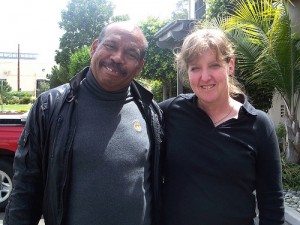
Fr. Jon got to know Aour neighbors on the streets,” as he calls them, and earned their trust. He heard their stories, made friends, helped where he could. They started to drop by his office on the church property during the week, and eventually, his other church work suffered. At the time, I was looking for a new job, and I was blessed to be offered a full-time job by the church in 2005: half-time raising money for our church school, St. John of Damascus Academy, and half-time working as assistant to Fr. Jon in his various duties.

Within a few months we realized that our work on the streets needed its own office. We rented space in the next-door medical clinic with a room for my office, a sitting area and supply closets, and a meeting room where mental health workers, job counselors and other providers could meet with us and our “clients.”

We opened the doors three mornings a week for drop-ins. Fr. Jon-Stephen named the ministry after St. Brigid, the Irish saint who was a compatriot of St. Patrick’s and who is commemorated both east and west. The scroll on her icon reads: “To care for the poor; To lighten everyone’s burden; To comfort the suffering.” This became our motto. The church agreed to a modest budget for our ministry.

Fr. Jon continued to see our neighbors in his office, but he was able to refer the simpler, day-to-day needs to me. The work started slowly. I handed out hygiene supplies, sleeping bags, coats, bus tokens, rain gear, and socks which were purchased by the church or donated. We offered the use of our telephone for calls and messages, and our address for applying for benefits and receiving mail. We served coffee. I met people and established friendships. I learned street names (Pirate, Wolf, Leprechaun, Veg-man) and their real names. I learned how to respond to angry outbursts as well as abject misery. I laughed and cried with people. I heard what it was like to be on the streets: stories of how others treated them, looked at them, how inequitable the system was. I became used to missing teeth, dirty hands, unkempt hair. The requests were so direct: AIt was freezing last night. Do you have anything warm to wear?” “I need a tarp to put over my sleeping bag when it rains.” “How do I get on food stamps?” “Do you have clean socks?”

We never intended to meet every need, especially those that were addressed by other organizations in Santa Barbara. We installed a rack with brochures about local services. From the start we were blessed to have the presence of Jennifer Ferraez, a parishioner who is also a Santa Barbara County Mental Health Outreach Worker for the Homeless. She arranged weekly visits to St. Brigid as part of her outreach, and taught me about the resources available in our community. She also provided the mental health assessments, referrals and counseling so many of our people needed. She is my sounding board and an ever-ready source of information.

As my unhoused friends started to trust me, they confided more. In this some¬times painful, personal exchange I heard about failed marriages, abusive child¬hoods, deep sorrows. I often felt overwhelmed. Prayer became a constant ally. I met people who were alcoholic or drug dependent, had mental illness, chronic medical conditions B and some with all three. I had my first face to face conversation with someone who was psychotic (he confided he was a superhero and offered to teach me to fly.) Most wanted housing, some lived in vehicles, others were happy on the streets if they could keep warm and fed.

I learned to make referrals for food stamps and general relief, how to help someone apply for SSI. Sometimes I couldn’t help in any other way but to listen, and mostly this was the most important. A public health nurse visited once a week, and the clinic downstairs began to see homeless people without charge.

About a year into the work, we had to move while the clinic remodeled. Since the move was to be temporary, we rented a portable construction office for $125 a month, a large trailer that occupied four spaces in our parking lot. I hung yellow lace curtains in the windows, which were quite silly really. St. Brigid’s new home quickly became known as “the dumpster with curtains.”

In the narrow trailer I had two storage cabinets in the back, my desk, filing cabinet and computer in the middle, and a table in front across from the door for a coffee pot and a computer that people could use. We stored sleeping bags and blankets under a slanted, built-in drafting-table, and put the phone and reference books on top of it. Actually, this is all that’s needed to start an outreach ministry - an open door, some basic supplies, an open heart.

Jennifer continued to come in once a week and to the Monday night dinners to help and teach. Fr. Jon-Stephen’s office was still next door on the church property and he came by daily. People began to drop by in greater numbers, not just to get something they needed but to hang out and talk. A sense of community emerged.

Somewhere along the line I developed my two rules: the first is that St. Brigid’s is a place of peace, a refuge from the streets, and that shouting, swearing and anger belonged elsewhere. (Some of the men who came in were so sensitive that if someone outside even used a loud voice in happy conversation, they would become upset and unable to talk.) The second rule was not to take coffee from the coffee pot before it finished brewing. I also inconspicuously monitored conversations and re-directed any that were inappropriate or disruptive.

We started serving peanut butter and jelly and bread with the coffee; then we got a toaster. The food table was outside the trailer. When it was cold we all wore coats. We jury-rigged a tarp outside that we could sit under when it rained, but we still got wet. One particularly rainy, blustery day, a friend got a large tarp out of her van and we all worked together to hang it around the church’s Sunday awning. I learned how to make ties from pieces of torn t-shirt. It worked fairly well as the only rain shelter in the area that day. We used the trailer for two years, then found out that the medical clinic was sold and we could not return to our office there.

We recently moved into a larger trailer on the church property and now have the luxury of two rooms: one for an office, and the other for our food table, supplies, computers, chairs and beginning library. When it’s sunny we use the deck outside and when it rains, we will even have a roof. What a concept!

We’re now open five days a week for breakfast. With a grant we received we are hiring a 15-hour-a-week helper, Nikki Coalson, a young woman in our church. This means I can work with people in crisis while she makes sure everything runs smooth¬ly. We are applying for other grants to expand our services.

I wish I had time to tell you the stories. Each person has his/her own, and together we have made new ones. Our team B all part time in the work B has made referrals for alcohol/drug detox, found people housing, gotten them benefits, seen them succeed, seen them relapse and start drinking again, shared joys, arranged reunions with family, had friends die.

The Monday night dinners have continued, drawing more people, some who never come in the mornings. Members of our church and the community help cook and serve, including doctors, nurses and politicians. There is now a group of UCSB pre-med students who have started a group called “Street Health Outreach”. They also cook a Saturday morning breakfast once a month and do street rounds the other Saturdays.

St. Brigid Fellowship has become a community, and a unifying force in Isla Vista. Fr. Jon-Stephen works Athe big picture” to make connections with other agencies and publicize our work as well as continuing his personal relationships here. Fr. Jon carries a badge as Chaplain to the Santa Barbara Sheriff’s Department and several other agencies. On him, the badge is a bridge. He also has an Emergency Medical Technician (EMT-B) certification. All of us work together to solve homelessness one person at a time. We’re part of Santa Barbara County’s Ten Year Plan to End Chronic Homelessness.

As for philosophy, we use an “incarnational model,” meeting people on the streets as Jesus did, addressing immediate needs and starting relationships that can lead out of homelessness. This is not a one-way ministry, us to them. All of us, both housed and unhoused, work together to solve problems.

When things are tough, we look at others as Mother Teresa did, as Christ in his distressing disguise, and do all with love. As St. John Kronstadt reminds us: “Never confuse the person, formed in the image of God, with the evil that is in him; because evil is but a chance misfortune, an illness, a devilish reverie. But the very essence of the person is the image of God, and this remains in him despite every disfigurement.”

This work is a blessing. My faith has grown, as has my prayer life.

If you or your parish is considering starting an outreach ministry, just know that it can be done simply. The most important part is taking the time to listen and talk. Your ministry can be handing out socks or sack lunches in the park, or feeding people once a week, or giving gift certificates to fast food or grocery stores. Whatever it is, take the time to talk. Introduce yourself and ask their name. You would be surprised how meaningful just exchanging names is to a person who is used to being snubbed and ignored. Don’t think you have to address all of the problems you will encounter - just do your part and listen to the Lord who will walk along side you and give you guidance, joy and peace.

Feel free to contact me, Fr. Jon-Stephen Hedges, and Jennifer Ferraez at office@saintb.sbcoxmail.com, or (805) 968-8028.

Better yet, join us for breakfast and a cup of coffee. We would love to meet you.

Jill Wallerstedt has lived in Isla Vista, California for 30 years. She lives in a house dedicated to St. Xenia with two roommates and works for St Athanasius Orthodox Church as a homeless outreach worker and a fund-raising professional. Her dream is to be a full-time writer and live in community.

Then and Now: Confessions of an Outreach Worker

Then, when I saw a homeless person, I saw the dishevelment, shuffling, and shopping cart. Now I see a person with a story. Not likely a happy story, but there might be some joy in it. Maybe grace.

Then I saw filth, poor hygiene, beards and thought, go to a shelter. Now I know that the street is safer for some people, and there are not enough beds to go around for the rest.

Then I noticed the skin sores and rashes, hacking coughs, missing teeth. Now I see the bigger problems: the ?structure resistance” keeping a person away from services; the bad receptions at health clinics; the perfunctory dismissals for inability to pay; the lack of dental providers even for those with benefits.

Then I saw the blank stares and the “off in their own world” look and thought mental illness. Now I know that it might be a sane defense against the constant stares and comments of others.

Then I thought, get a job. Now I know the devastation of untreated mental illness and substance abuse, the consequences of severe child abuse, the effects of 35 years in jail. I know that the simple lack of a shower and clean clothes can cost a person their job.

Then I asked, Why doesn’t someone solve this problem? Now I ask - what is your name? Do you have somewhere safe to sleep? Are you warm enough? Do you want to talk?

Then I saw anonymous people, lumped together in my brain in the category “Avoid if at all possible, be kind if not able to avoid, keep your hand on your purse.” Now I know Rainbow from Little Rick. I know how people get their street names: Nira Dave, Buckethead, Veg-man. More importantly I know their given names, the names I call them by. A name is the beginning of identity.

Then I thought all homeless were alike. Now I know that some avoid everyone, including other homeless people, while others find strength in numbers. I know who drinks to excess and who can hold their liquor, who I can count on for help and who will just use me. I know why the women are on the street and why they always have a boyfriend, no matter how bad he is.

Then I believed everyone’s story. Now I take everything with a grain of salt until I can verify it.

Then I felt lower middle class, comparing myself to most others in Santa Barbara. Now, my car, roof, shower, washer, money, and health insurance seem like incredible wealth. Keys are a status symbol.

Then I wondered where brilliance and madness intersected and how to tell the difference. I still wonder.

Then I saw objects. Now I see individuals.

C Jill Wallerstedt

source: http://incommunion.org/?p=1066

Wednesday, January 14, 2009

Time to Stop the Mideast Comparisons

http://www.truthdig.com/report/item/20090110_time_to_stop_the_mideast_comparisons/

By Robert Fisk

This article was originally printed in The Independent.

It all depends where you live. That was the geography of Israel’s propaganda, designed to demonstrate that we softies—we little baby-coddling liberals living in our secure Western homes—don’t realise the horror of 12 (now 20) Israeli deaths in 10 years and thousands of rockets and the unimaginable trauma and stress of living near Gaza. Forget the 600 Palestinian dead; travelling on both sides of the Atlantic these past couple of weeks has been an instructive—not to say weirdly repetitive—experience.

Here’s how it goes. I was in Toronto when I opened the right-wing National Post and found Lorne Gunter trying to explain to readers what it felt like to come under Palestinian rocket attack. “Suppose you lived in the Toronto suburb of Don Mills,” writes Gunter, “and people from the suburb of Scarborough—about 10 kilometres away—were firing as many as 100 rockets a day into your yard, your kid’s school, the strip mall down the street and your dentist’s office…”

Getting the message? It just so happens, of course, that the people of Scarborough are underprivileged, often new immigrants—many from Afghanistan—while the people of Don Mills are largely middle class with a fair number of Muslims. Nothing like digging a knife into Canada’s multicultural society to show how Israel is all too justified in smashing back at the Palestinians.

Now a trip down Montreal way and a glance at the French-language newspaper La Presse two days later. And sure enough, there’s an article signed by 16 pro-Israeli writers, economists and academics who are trying to explain what it feels like to come under Palestinian rocket attack. “Imagine for a moment that the children of Longueuil live day and night in terror, that businesses, shops, hospitals, schools are the targets of terrorists located in Brossard.” Longueuil, it should be added, is a community of blacks and Muslim immigrants, Afghans, Iranians. But who are the “terrorists” in Brossard?

Two days later and I am in Dublin. I open The Irish Times to find a letter from the local Israeli ambassador, trying to explain to the people of the Irish Republic what it feels like to come under Palestinian rocket attack. Know what’s coming? Of course you do. “What would you do,” Zion Evrony asks readers, “if Dublin were subjected to a bombardment of 8,000 rockets and mortars…” And so it goes on and on and on. Needless to say, I’m waiting for the same writers to ask how we’d feel if we lived in Don Mills or Brossard or Dublin and came under sustained attack from supersonic aircraft and Merkava tanks and thousands of troops whose shells and bombs tore 40 women and children to pieces outside a school, shredded whole families in their beds and who, after nearly a week, had killed almost 200 civilians out of 600 fatalities.

In Ireland, my favourite journalistic justification for this bloodbath came from my old mate Kevin Myers. “The death toll from Gaza is, of course, shocking, dreadful, unspeakable,” he mourned. “Though it does not compare with the death toll amongst Israelis if Hamas had its way.” Get it? The massacre in Gaza is justified because Hamas would have done the same if they could, even though they didn’t do it because they couldn’t. It took Fintan O’Toole, The Irish Times’s resident philosopher-in-chief, to speak the unspeakable. “When does the mandate of victimhood expire?” he asked. “At what point does the Nazi genocide of Europe’s Jews cease to excuse the state of Israel from the demands of international law and of common humanity?”

I had an interesting time giving the Tip O’Neill peace lecture in Derry when one of the audience asked, as did a member of the Trinity College Dublin Historical Society a day later, whether the Northern Ireland Good Friday peace agreement—or, indeed, any aspect of the recent Irish conflict—contained lessons for the Middle East. I suggested that local peace agreements didn’t travel well and that the idea advanced by John Hume (my host in Derry)—that it was all about compromise—didn’t work since the Israeli seizure of Arab land in the West Bank had more in common with the 17th-century Irish Catholic dispossession than sectarianism in Belfast.

What I do suspect, however, is that the split and near civil war between Hamas and the Palestinian Authority has a lot in common with the division between the Irish Free State and anti-treaty forces that led to the 1922-3 Irish civil war; that Hamas’s refusal to recognise Israel—and the enemies of Michael Collins who refused to recognise the Anglo-Irish Treaty and the border with Northern Ireland—are tragedies that have a lot in common, Israel now playing the role of Britain, urging the pro-treaty men (Mahmoud Abbas) to destroy the anti-treaty men (Hamas).

I ended the week in one of those BBC World Service discussions in which a guy from The Jerusalem Post, a man from al-Jazeera, a British academic and Fisk danced the usual steps around the catastrophe in Gaza. The moment I mentioned that 600 Palestinian dead for 20 Israeli dead around Gaza in 10 years was grotesque, pro-Israeli listeners condemned me for suggesting (which I did not) that only 20 Israelis had been killed in all of Israel in 10 years. Of course, hundreds of Israelis outside Gaza have died in that time—but so have thousands of Palestinians.

My favourite moment came when I pointed out that journalists should be on the side of those who suffer. If we were reporting the 18th-century slave trade, I said, we wouldn’t give equal time to the slave ship captain in our dispatches. If we were reporting the liberation of a Nazi concentration camp, we wouldn’t give equal time to the SS spokesman. At which point a journalist from the Jewish Telegraph in Prague responded that “the IDF are not Hitler”. Of course not. But who said they were?

Why Do They Hate the West So Much, We Will Ask

http://www.truthdig.com/report/item/20090109_why_do_they_hate_the_west_so_much_we_will_ask/

By Robert Fisk

This article was originally printed in The Independent.

So once again, Israel has opened the gates of hell to the Palestinians. Forty civilian refugees dead in a United Nations school, three more in another. Not bad for a night’s work in Gaza by the army that believes in “purity of arms”. But why should we be surprised?

Have we forgotten the 17,500 dead—almost all civilians, most of them children and women—in Israel’s 1982 invasion of Lebanon; the 1,700 Palestinian civilian dead in the Sabra-Chatila massacre; the 1996 Qana massacre of 106 Lebanese civilian refugees, more than half of them children, at a UN base; the massacre of the Marwahin refugees who were ordered from their homes by the Israelis in 2006 then slaughtered by an Israeli helicopter crew; the 1,000 dead of that same 2006 bombardment and Lebanese invasion, almost all of them civilians?

What is amazing is that so many Western leaders, so many presidents and prime ministers and, I fear, so many editors and journalists, bought the old lie; that Israelis take such great care to avoid civilian casualties. “Israel makes every possible effort to avoid civilian casualties,” yet another Israeli ambassador said only hours before the Gaza massacre. And every president and prime minister who repeated this mendacity as an excuse to avoid a ceasefire has the blood of last night’s butchery on their hands. Had George Bush had the courage to demand an immediate ceasefire 48 hours earlier, those 40 civilians, the old and the women and children, would be alive.

What happened was not just shameful. It was a disgrace. Would war crime be too strong a description? For that is what we would call this atrocity if it had been committed by Hamas. So a war crime, I’m afraid, it was. After covering so many mass murders by the armies of the Middle East—by Syrian troops, by Iraqi troops, by Iranian troops, by Israeli troops—I suppose cynicism should be my reaction. But Israel claims it is fighting our war against “international terror”. The Israelis claim they are fighting in Gaza for us, for our Western ideals, for our security, for our safety, by our standards. And so we are also complicit in the savagery now being visited upon Gaza.

I’ve reported the excuses the Israeli army has served up in the past for these outrages. Since they may well be reheated in the coming hours, here are some of them: that the Palestinians killed their own refugees, that the Palestinians dug up bodies from cemeteries and planted them in the ruins, that ultimately the Palestinians are to blame because they supported an armed faction, or because armed Palestinians deliberately used the innocent refugees as cover.

The Sabra and Chatila massacre was committed by Israel’s right-wing Lebanese Phalangist allies while Israeli troops, as Israel’s own commission of inquiry revealed, watched for 48 hours and did nothing. When Israel was blamed, Menachem Begin’s government accused the world of a blood libel. After Israeli artillery had fired shells into the UN base at Qana in 1996, the Israelis claimed that Hizbollah gunmen were also sheltering in the base. It was a lie. The more than 1,000 dead of 2006—a war started when Hizbollah captured two Israeli soldiers on the border—were simply dismissed as the responsibility of the Hizbollah. Israel claimed the bodies of children killed in a second Qana massacre may have been taken from a graveyard. It was another lie. The Marwahin massacre was never excused. The people of the village were ordered to flee, obeyed Israeli orders and were then attacked by an Israeli gunship. The refugees took their children and stood them around the truck in which they were travelling so that Israeli pilots would see they were innocents. Then the Israeli helicopter mowed them down at close range. Only two survived, by playing dead. Israel didn’t even apologise.

Twelve years earlier, another Israeli helicopter attacked an ambulance carrying civilians from a neighbouring village—again after they were ordered to leave by Israel—and killed three children and two women. The Israelis claimed that a Hizbollah fighter was in the ambulance. It was untrue. I covered all these atrocities, I investigated them all, talked to the survivors. So did a number of my colleagues. Our fate, of course, was that most slanderous of libels: we were accused of being anti-Semitic.

And I write the following without the slightest doubt: we’ll hear all these scandalous fabrications again. We’ll have the Hamas-to-blame lie—heaven knows, there is enough to blame them for without adding this crime—and we may well have the bodies-from-the-cemetery lie and we’ll almost certainly have the Hamas-was-in-the-UN-school lie and we will very definitely have the anti-Semitism lie. And our leaders will huff and puff and remind the world that Hamas originally broke the ceasefire. It didn’t. Israel broke it, first on 4 November when its bombardment killed six Palestinians in Gaza and again on 17 November when another bombardment killed four more Palestinians.

Yes, Israelis deserve security. Twenty Israelis dead in 10 years around Gaza is a grim figure indeed. But 600 Palestinians dead in just over a week, thousands over the years since 1948—when the Israeli massacre at Deir Yassin helped to kick-start the flight of Palestinians from that part of Palestine that was to become Israel— is on a quite different scale. This recalls not a normal Middle East bloodletting but an atrocity on the level of the Balkan wars of the 1990s. And of course, when an Arab bestirs himself with unrestrained fury and takes out his incendiary, blind anger on the West, we will say it has nothing to do with us. Why do they hate us, we will ask? But let us not say we do not know the answer.

Tuesday, January 13, 2009

[Saint-george-taybeh] Gaza


Greetings from Boston

and hope you are having a good day
if you like the following article, please share it with others, you local publications
or any website that might help spread more awarness, if you have time
you can listen to the new song by Michael Heart


http://www.youtube.com/watch?v=dlfhoU66s4Y <http://www.youtube.com/watch?v=dlfhoU66s4Y>

God be with you, maria
 
Lethal Competition in the Holy Land
Maria C. Khoury, Ed. D.
I think I became angry at my brother the other day expressing my wish and hope that the Israeli leadership should be punished over the accused war crimes in Gaza.  
So my brother just laughed on the phone saying:  “Don’t hold your breath…Remember they are the Chosen People…Israel is above all laws...”  
I am deeply trying to reflect that the “Chosen People” did not actually even accept the Messiah or the reason that God selected them to deliver salvation to humanity which actually, I, as an Orthodox Christian baptized onto Christ became the New Israel since Christians accept Christ as Lord and savior, are we not the Spiritual Israel?
Please don’t be confused that the Israel we sing and chant in our gospels is the Israel on the ground right now with the tanks, the gunships and the war tactics.  
Our Israel is a spiritual homeland.  The Israel that right now  is using white phosphorous chemical warfare and dense inert metal explosives in Gaza to cut human beings into hundreds of pieces or if these Palestinians survive this new type of high density explosive they will have long term cancer effects, is not the Israel of my gospels.  
Even if you are the “Chosen People,” it does not allow you to treat other human beings with cruelty and killing more than 930 and injuring over 4,000 in less than eighteen days.  No descent person or chosen person should act or react with this madness because it goes against humanity and what it means to be a descent human being.
Gaza has seen the worst carnage ever with this deadly game that Israel and Hamas are literally playing with innocent civilian lives.  I remember when my son Canaan was born, Feb 27, 1987, there was not even a Hamas member in existence but Israel had to find a way to break the word of the late Yasser Arafat in the streets of the West Bank and to find ways to divide the Palestinians.   Israel supported the creation of Hamas as the Islamic Resistance Movement since Arafat and his Fatah movement wanted a secular free Palestine.   
A handful of Hamas members emerged and than we began to see hundreds, thousands until finally in January 2006, fair and square, under international microscope, Hamas won the majority of the votes for the Palestinian Parliament and became millions in numbers.  But, with this Hamas victory, it is the Palestinian people that had to pay the highest price following the international financial boycott which collapsed the country since the world did not like the way the Palestinians voted and this finally led to Palestinians killing each other.   
Right now on the ground in Palestine, for all those of us who never supported Hamas and are not Hamas members, after this brutal and fierce fighting in Gaza, I am thinking each and every Palestinian will be a Hamas supporter. Violence is never the answer but this war will help create more fanatics.  It will never finish until each and every Palestinian is dead.  And right now, those of us modern, moderate people who are working for freedom in Palestine using peaceful methods are losing ground.
The Israelis have been successful to completely take everything from the Palestinians, their homes, their lands, personal properties, their future and their hope but the one thing they want to specifically destroy, especially with this war, is the will power of the Palestinian child to be free.  It is this spirit that cannot be destroyed.  Living on the wrong side of the Wall, in a complete open prison which sometimes I escape because of my American passport, makes me see that Palestinians need peace with justice.  I really don’t understand how there will be peace for Israel and the right for Israel to exist when for the last nine years in the West Bank and Gaza our life as normal has stopped to exist and people forget that Palestinians cannot do simple things like  freely go to school, work, hospitals, holy places, etc. Israel controls all the boarders and their security and brutal occupation has cost the United States government more than 100 billion dollars since the creation of Israel (1948). Of course, oppressed people will resist and it will continue to cost the American taxpayer more than 6.8 billion dollars a day until the international community looks at the root cause of the problem not just military solutions.

As the battle rages fiercely in Gaza, I am not sure what language people feel comfortable using.  
I mean they don’t like words like ethnic cleansing, genocide or massacre or slaughter but really, please, give me one good word when entire families are killed at the same spot, the mom and the kids and the grandmother and hundreds of them at the same time.  Don’t bother to Google the photos you will simply throw up at the violent graphics.
Please give me a nice word when no one condemns the Israeli occupation forces for their attacks on journalists and media outlets and the enormous devastation and humanitarian disaster.  I cannot keep up with the statistics after four journalists were killed, eight mosques were bombed, the schools, the hospitals and the one hundred thousand people that had to flee their homes for safety in a place that has nothing safe about it.
Please give me a nice word when many people like doctors, human rights workers and members of several European parliaments want to take medical supplies into Gaza and help Palestinians but Israel continues the blockade.  Or when hospitals supported by a global humanitarian alliance of churches and agencies are targeted by F16 fighter jets of the Israeli Air Force forcing them to shut down and not give the desperate needed medical services.   

Reflecting more carefully, I can see why my brother is laughing at my undying hope since Israel is the target of at least 65 United National Resolutions for its violations of human rights and still the American government has no harsh words to tell them.  Furthermore, since 2000 the Israeli army has uprooted and destroyed more than one million trees to punish Palestinians and since 1967 has demolished more than 18,000 Palestinian homes but no one is telling them to stop.

At the end of the day, Israel and Hamas must talk so why do they have to be responsible for so much bloodshed?  Pray for a peace with justice and this madness to stop.  If you believe in the “one person can make a difference” philosophy contact your senators and representatives and ask them to hold both sides accountable and vote for the security and human rights for all people not just Israel since technically speaking what fault did the Palestinians have to pay the price for the discrimination that Jews received in Europe. What right did Britain have to grant Jews another people’s country.  But these are not popular questions in our media and instead everyone is sending me emails asking me why is Hamas firing rockets into Israel?  

There is no simple answer and you don’t have to live there to see that more understanding and reconciliation is needed on all sides and this is exactly why our Christian presence is more important than ever in a land that needs the message of Christ’s peace and love for humanity.  It has been more than two thousand years after Christ’s birth in the Holy Land and I guess not much has changed.  But it reaffirms that the hope of each and every Christian is the promise of eternal life.  (John 3:16; John 6:40)

Prayer for peace

For God’s mercy upon us, His unworthy servants, that we may all be protected from hatred and evil actions, that we may have instilled in us unselfish love by which all shall know that we are disciples of Christ and God’s people, as were our holy ancestors, so that we may always know to decide for the truth and righteousness of the Heavenly Kingdom, let us pray to the Lord.

For all those who commit injustice against their neighbors, whether by causing sorrow to orphans or spilling innocent blood or by returning hatred for hatred, that God will grant them repentance, enlighten their minds and hearts and illumine their souls with the light of love even towards their enemies, let us pray to the Lord.

O Lord, how many are our foes who battle against us and say: there is no help for them from God or man. O Lord, stretch forth Thy hands that we may remain Thy people in both faith and works. If we must suffer, let it by in the ways of Thy justice and Thy truth — let it not be because of our injustice or hatred against anyone. Let us all fervently say: Lord have mercy.

Again let us pray to God, the Savior of all men, also for our enemies — that our people Lord who loves mankind will turn them away from attacks on our Orthodox people, that they not destroy our churches and cemeteries, that they not kill our children or persecute our people, but that they too may turn to the way of repentance, justice and salvation. Let us all fervently say: Lord have mercy.